Introduction
In this article, Eng. Alireza Kanaanee, Technical Engineering & Production Deputy, examines the phenomenon of inrush current, the factors contributing to its occurrence, and its impact on transformers used in electric arc furnaces. The study also investigates an approach based on Wavelet Transform and an Adaptive Neuro-Fuzzy Inference System (ANFIS) for detecting inrush current and distinguishing it from fault current.
Start-Up Challenges of Electric Arc Furnace Transformers
Transformers used in electric arc furnaces are generally exposed to significant electrical stresses due to the nature of the load and the specific start-up conditions. During furnace start-up, the current conditions may result in extremely high currents in the circuit, with the furnace being energized under short-circuit conditions. Therefore, the electrical stresses imposed on these transformers during start-up represent one of the major challenges that must be taken into consideration during the operation of such furnaces.
Since electric arc furnace transformers are started and operated under short-circuit conditions, overcurrent-related faults can occur frequently at the initial stage of start-up.
Consequently, even with precise settings of the current protection relays, improper execution of the start-up procedure may prevent the transformer and furnace from starting in a single stage, requiring the start-up process to be repeated in two or even three stages.
Inrush Current in Transformers
Inrush current is another phenomenon that can interfere with furnace start-up. By causing protective relays to incorrectly identify the current condition as a fault, inrush current may prevent electric arc furnaces from starting successfully and consequently increase the number of start-up attempts.
Repeated transformer start-ups can impose additional electrical stresses on the equipment. As a result, the probability of major failures and complete transformer outages caused by internal winding short circuits may increase.
Therefore, repeated start-up attempts in such furnaces should be strictly avoided, and appropriate operating conditions should be provided for transformer start-up.
The identification of inrush current and its discrimination from fault currents in transformers has become an important subject of research, with numerous studies focusing on the development of reliable detection methods.
Simulation of the Proposed Algorithm
Based on the proposed algorithm, which employs Wavelet Transform and an Adaptive Neuro-Fuzzy Inference System (ANFIS), a simulation program was developed and implemented. The results demonstrate the capability of the developed program to detect and distinguish inrush current from fault current within a short time interval.
Under normal conditions, a transformer operating at no load draws a magnetizing current of approximately 0.5% to 2% of its rated current from the source. The degree of waveform distortion depends on the magnetic flux density at which the transformer core operates.
The variations in core flux and magnetizing current are such that the hysteresis loop is traversed once during each cycle. Although advances in transformer core design and manufacturing have improved the behavior of magnetic flux, this phenomenon has not been completely eliminated.
The transformer core also generates the required electromotive force (EMF) at each instant to balance the instantaneous source voltage. As the applied voltage increases, a greater magnetic flux passes through the core, and the current increases rapidly as the core approaches magnetic saturation.
Therefore, even after the transformer is disconnected from the source, a significant amount of residual flux may remain in the core. This residual flux can cause the core to enter magnetic saturation when the transformer is re-energized, resulting in a very large current drawn from the supply. This current is known as inrush current.
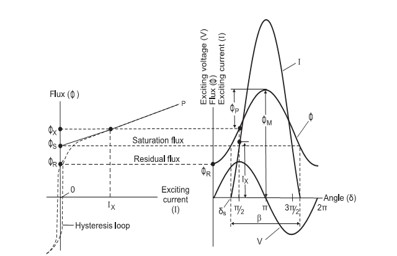
According to technical literature and published studies, the peak magnitude of inrush current in conventional power transformers can typically reach approximately 10 times the rated current, and in some cases values of 15 to 20 times the rated current has been reported. The magnitude depends on the transformer’s construction parameters, its position within the power network, and switching conditions.
The duration of the inrush current until complete decay also varies among transformers. According to technical references and published studies, this period can generally range from approximately 10 cycles to one minute, and in some cases may extend to several minutes.
The decay time depends on several factors, including the voltage-wave angle at the instant the transformer is energized, the magnitude and polarity of the residual flux, the magnetic properties of the transformer, electrical resistance, circuit losses, and frequency.
Major Factors Affecting Inrush Current
In general, inrush current is influenced by the following factors:
- Dimensions of the transformer core and windings, as well as the distances between them
- Type of magnetic steel used in the core and other transformer components
- Core saturation flux density
- Power-system characteristics, including the resistance and inductance of the supply source
- Magnitude and polarity of the core residual flux
- Voltage-wave angle at the instant the transformer is energized
Conclusion
The proposed detection algorithm is designed to distinguish inrush current from fault current within a very short time interval.
The algorithm is based on Wavelet Transform and ANFIS and demonstrates good capability in differentiating between these two types of current.
Based on the proposed algorithm and the parameters introduced within the model, a simulation program was developed and implemented. The results demonstrate the capability of the system to distinguish inrush current from fault current.
Consequently, the proposed approach has the potential to be integrated with equipment capable of controlling the operation of current protection relays. This could significantly reduce unwanted protective relay operations that may otherwise prevent the successful start-up of transformers used in electric arc furnaces, while maintaining appropriate protection against genuine fault conditions.