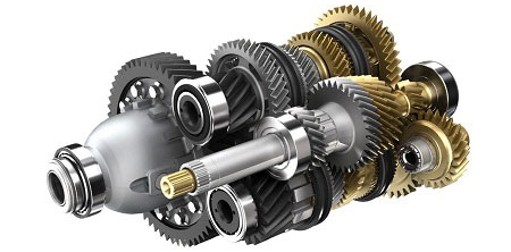
In this series, we explore various types of industrial gearboxes, from commonly used models such as worm and helical gearboxes to more advanced types such as harmonic and magnetic gearboxes. We examine the key features, advantages, and applications of each type.
This series will be published in several parts. In Part 1, we will introduce the structure, operation, and applications of some of the most common types of industrial gearboxes.
Stay tuned for the next parts of this series.
At first glance, a gearbox may appear to be nothing more than an assembly of gears with different shapes and sizes. However, behind every design lies an engineering philosophy. Power transmission, speed and torque control, changing the direction of motion, and adapting to operating conditions are just some of the functions that a gearbox performs in mechanical and industrial systems. Some gearboxes are classified based on the type of gears they use, others according to the direction of power transmission, while others are categorized based on operating conditions and available space.
What is a gearbox, and what is its function?
To put it simply, a gearbox is an intelligent mechanical unit responsible for transmitting power from the engine to other parts of the machinery. This transmission is carried out in a way that controls and regulates output speed, direction, and power. In fact, if the engine is considered the heart of a mechanical system, the gearbox acts as its brain; without it, controlling movement would be impossible.
Every engine performs optimally within a specific speed range (RPM). However, in practice, we require varying speeds for different applications. This is where the gearbox comes into play.
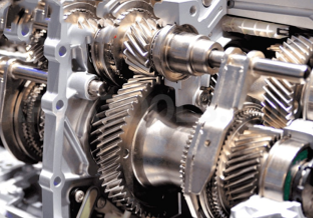
A gearbox controls torque by either reducing or increasing the motor's rotational speed. For instance, heavy-duty applications like conveyor systems require slow yet powerful movement, whereas packaging machinery prioritizes speed. Consequently, the gearbox plays a pivotal role in optimizing equipment performance.
Why is selecting the right type of gearbox important?
Given that each gearbox model possesses distinct characteristics and structural designs (e.g., worm, helical, planetary, etc.), an incorrect choice can lead to reduced system efficiency, increased energy consumption, rapid component wear, and even a complete production line stoppage.
Therefore, a thorough understanding of gearbox types—and the selection of a model suited to the specific load, required speed, installation space, and environmental conditions—ranks among the most critical technical decisions in any industrial project.
Types of gearboxes:
Selecting the appropriate gearbox from the wide range of available types can have a significant impact on the efficiency, service life, reliability, and overall performance of a mechanical system.
Depending on their gear geometry, power transmission configuration, and the manner in which their components engage with one another, different gearbox designs offer distinct performance characteristics and advantages.
The following sections introduce some of the most commonly used industrial gearbox types, along with an overview of their operating principles and structural characteristics.
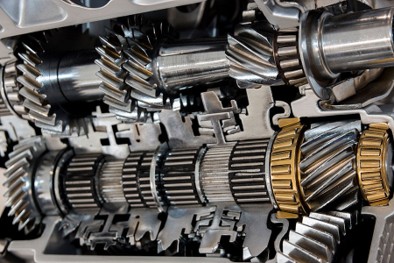
- Worm Gearbox
- Helical Gearbox
- Planetary Gearbox
- Inline Gearbox
- Shaft-Mounted Gearbox
- Variable Speed Gearbox
- Worm Gearbox
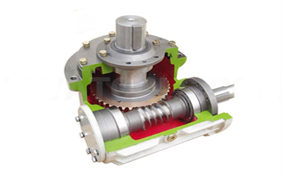
The worm gearbox is one of the most widely used types of gearboxes, particularly in applications with limited installation space and systems requiring 90-degree power transmission.
The gearbox consists of two main components:
- Worm Shaft: A shaft with a helical thread that operates similarly to a screw.
- Worm Wheel: A gear with curved teeth that meshes with the worm shaft.
This unique meshing arrangement enables a high reduction ratio within a compact package. Other notable characteristics of worm gearboxes include low noise, smooth operation, and self-locking capability under certain back-driving conditions.
Applications
Worm gearboxes are commonly used in:
- Elevators and lifting systems
- Small conveyor systems
- Packaging machinery
- Automatic doors and gate systems
Advantages of Worm Gearboxes
- Compact and space-saving design
- Smooth and quiet power transmission
- Self-locking capability in applications where reverse motion or back-driving is not required
The efficiency of a worm gearbox is generally lower than that of helical or planetary gearboxes. However, for low-speed, high-torque applications, worm gearboxes can provide an economical, reliable, and effective transmission solution.
- Helical Gearbox
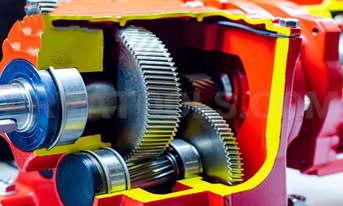
The helical gearbox is one of the most important and widely used types of gearboxes in industrial applications. The primary difference between helical gearboxes and simpler gearbox designs lies in the geometry of their gears: the teeth are designed at an inclined angle (helical) rather than being straight. This angular configuration allows the gears to engage more smoothly, continuously, and with greater load-carrying capacity.
Due to the continuous and gradual engagement of the gear teeth, helical gearboxes offer excellent performance in terms of energy efficiency, heavy-load handling, and noise reduction. Key features of helical gearboxes include:
- Helical gear teeth for continuous and smooth engagement
- High power transmission capacity, even at high operating speeds
- Lower noise levels compared with straight-tooth gearboxes
- High efficiency, reaching approximately 95%
Helical gearboxes are widely used in the following applications:
- Factory production lines
- Industrial conveyor systems
- Mining machinery
- Heavy-duty power transmission systems in the petrochemical, steel, and cement industries
Overall, a helical gearbox is a powerful, high-efficiency, and smooth-running transmission solution designed for continuous operation in demanding industrial environments.
- Planetary Gearbox
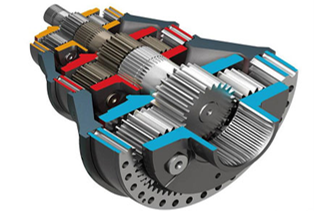
One of the most advanced and compact types of gearboxes used in heavy-duty and precision industries is the planetary gearbox, also known as an epicyclic gearbox.
In this type of gearbox, the transmitted load is distributed evenly among multiple gears, allowing the system to deliver very high torque within a compact footprint.
In addition to providing high power and excellent durability, planetary gearboxes require relatively little installation space, making them particularly suitable for modern machinery and dynamic applications.
- Inline Gearbox
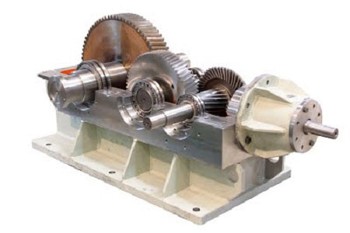
Systems such as conveyors and industrial packaging lines predominantly use inline gearboxes. This type of gearbox is designed for direct power transmission and features a simple, compact, and practical configuration.
In an inline gearbox, the input and output shafts are aligned on the same axis or positioned at a slight angle relative to each other. Unlike gearboxes that transmit power through a change in direction, such as worm or bevel gearboxes, power transmission in an inline gearbox is linear, direct, and straightforward.
The simple design, high efficiency, and low maintenance requirements are among the main reasons for the widespread use of inline gearboxes. In addition, this type of gearbox is particularly well suited to applications requiring continuous, uninterrupted operation.
Common Applications
- Material handling and conveying systems
- Food and pharmaceutical production lines
- Packaging machinery
- Light-duty mixers and agricultural machinery
When selecting an inline gearbox, careful consideration should be given to the shaft rotation direction, mounting position, and required power transmission capacity to ensure optimum system efficiency and reliable operation.
- Shaft-Mounted Gearbox
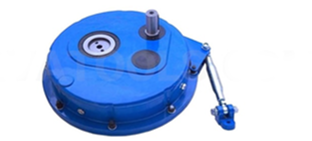
Among the various types of industrial gearboxes, the shaft-mounted gearbox is widely used in heavy-duty machinery and continuous production lines due to its ability to be mounted directly onto the driven shaft or machine structure.
The shaft-mounted gearbox is designed to be installed directly on the machine, without the need for an additional base or coupling. This configuration helps save installation space, reduce vibration, and provide smooth and uniform power transmission.
In this type of gearbox, the shafts are arranged in parallel, and power is transmitted through helical gears. This configuration contributes to high efficiency, reduced mechanical wear, and smooth operation under continuous loads.
Thanks to its high-power transmission capacity and excellent mechanical durability, shaft-mounted gearboxes are widely used in the following industries and applications:
- Continuous and 24/7 production lines
- Heavy-duty machinery, including mills, industrial conveyors, and large-capacity mixers
- Material handling equipment in the steel, cement, and petrochemical industries
Overall, the shaft-mounted gearbox provides a compact, reliable, and efficient power transmission solution for heavy-duty applications where space optimization, continuous operation, and direct installation are important requirements.
- Bevel Gearbox
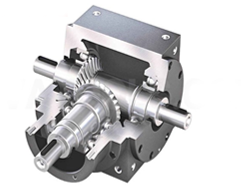
The bevel gearbox is a type of angular gearbox designed to transmit power between intersecting shafts, typically at a 90-degree angle. Its operation is based on bevel gears, whose angled tooth engagement enables the transmission system to change the direction of rotation.
Operating Principle of a Bevel Gearbox
The basic operating configuration of a bevel gearbox is as follows:
- Driving Bevel Gear (Pinion): Mounted on the input shaft, the pinion transmits rotational motion to the driven gear.
- Driven Bevel Gear (Crown Gear): Located on the output shaft, the crown gear receives the transmitted power at the required angle, typically 90 degrees.
- Gear Tooth Design: Depending on the application, the gears may feature straight, spiral, or hypoid teeth, which influence the gearbox's precision, efficiency, load-carrying capability, and noise level.
Common Applications
Bevel gearboxes are widely used in applications such as:
- Industrial agitators
- Chemical mixers
- Drilling equipment
- Agricultural machinery
- Power transmission systems requiring angular drive configurations
Advantages of Bevel Gearboxes
- Power transmission at specific angles
- Customizable design for space-constrained installations
- Stable operation under shock loads and reversing or reciprocating operating conditions
A bevel gearbox is particularly suitable when the application requires the direction of power transmission to be changed at a specific angle.
Among the various types of gearboxes, this configuration is especially useful in applications with limited installation space or complex layout requirements, where flexibility in power transmission is essential.