In the second part of the article “Introduction to Gearbox Types: From Power Transmission to Smart Selection,” we explore additional types of industrial gearboxes, along with their technical characteristics and applications. This section introduces variable-speed, spur, bevel, epicyclic, harmonic drive, and magnetic gearboxes. By examining their structures, operating principles, and advantages, we will explore the key differences between these types of equipment.
Since selecting the right gearbox plays an important role in the performance, efficiency, and reliability of industrial equipment, we will also discuss the main selection criteria, including load and power requirements, input and output speeds, installation space, environmental conditions, and maintenance requirements. The aim is to provide a more comprehensive understanding of industrial gearbox types and a clearer insight into the factors that influence the selection of the most suitable gearbox for each application.
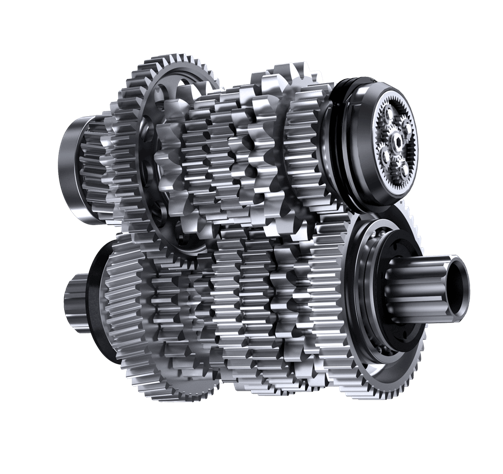
- Variable speed gearbox
- Spur gearbox
- Bevel gearbox
- Epicyclic gearbox
- Harmonic drive
- Magnetic gearbox
- Key considerations for selecting the right gearbox
- Variable speed gearbox
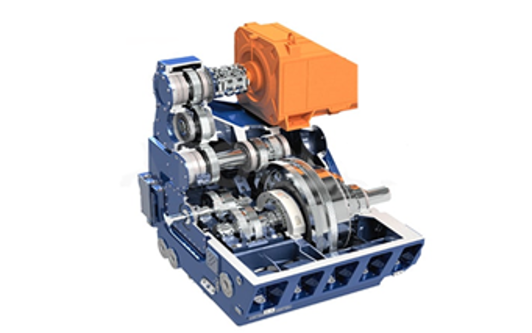
The variable speed gearbox is one of the most versatile options among industrial gearbox types, allowing the operator to adjust the output speed and torque either manually or automatically.
These gearboxes typically utilize mechanisms such as variable-diameter pulleys, adjustable bevel gears, or electromechanical systems. By changing the transmission ratio during operation, the output speed can be precisely controlled without the need to stop the system.
Precise Speed Control
One of the key advantages of a variable speed gearbox is its ability to provide precise control over the output speed. The operator can accurately match the output speed to the specific requirements of the process. This capability is particularly important in systems where the load and operating conditions continuously change.
Variable speed gearboxes are commonly used in:
- Packaging machinery
- Conveyors with variable loads
- Textile and printing industries
- Assembly lines and food processing systems
- Advanced agricultural machinery
Maintenance Requirements
Variable speed gearboxes require specialized maintenance. Due to their mechanical and/or electronic complexity, periodic inspection, proper lubrication, and functional calibration are essential for maintaining reliable performance and extending the service life of the equipment.
- Spur gearbox
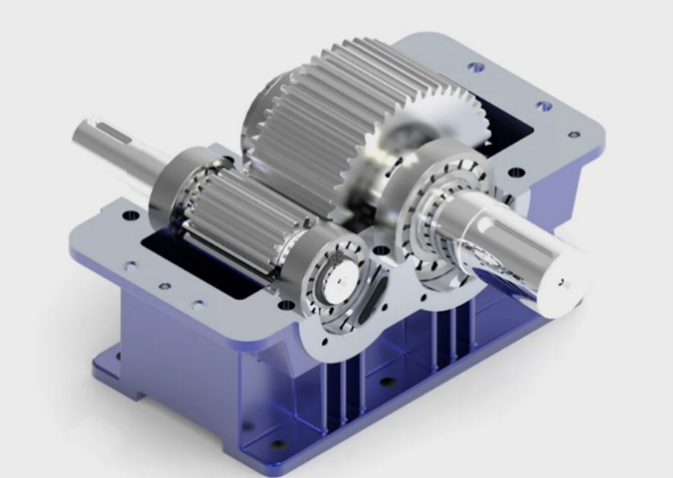
Among the various types of gearboxes, the spur gearbox is one of the simplest in terms of design and construction. It consists of one or more gears with straight teeth arranged parallel to the axis of rotation, allowing power to be transmitted in a linear direction without changing the transmission angle.
The simplicity of this gearbox design offers two major advantages:
First, it results in low manufacturing costs. Second, it provides high efficiency under constant-load conditions and at low to moderate operating speeds.
However, at high speeds or under heavy loads, the abrupt engagement of the gear teeth can result in increased noise, vibration, and mechanical wear.
Key Technical Features of Spur Gearboxes
- Straight teeth with a zero-helix angle
- Direct power transmission without lateral tooth sliding
- Suitable for low-speed applications
- Easy installation and maintenance
Applications of Spur Gearboxes
- Light-duty industrial machinery
- Simple mechanical equipment
- Semi-automatic machines
- Low-load power transmission equipment
Limitations of Spur Gearboxes
- High noise levels at high rotational speeds
- Sensitivity to shock and impact loads
- Lower load-carrying capacity compared with helical or planetary gearboxes
Although the spur gearbox is one of the most basic options among gearbox types, it can still be a practical and cost-effective solution for many light-duty applications and projects where budget constraints are an important consideration.
- Bevel gearbox
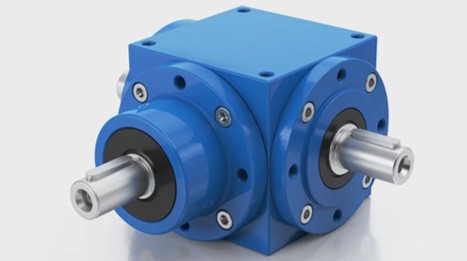
The bevel gearbox is a type of gearbox designed to transmit power between intersecting shafts, particularly at a 90-degree angle. In this design, the gears feature conical surfaces, with their angled or spiral tooth engagement enabling smoother and more precise power transmission.
|
Features
|
Application
|
|
Bevel gear designs available at various angles
|
Suitable for power transmission between intersecting shafts
|
|
Option to use straight, spiral, or hypoid gears
|
Used in industrial agitators and combined machinery
|
|
Reliable performance when changing the direction of torque transmission
|
Cranes, mills, and angular conveyor systems
|
|
High efficiency, particularly in spiral bevel gear designs
|
Power transmission equipment for space-constrained angular installations
|
|
Lower noise levels compared with spur gears in angular transmission applications
|
Drive systems with complex layouts and limited installation space
|
Application
Among various types of angular gearboxes, the bevel gearbox is one of the most widely used options in medium- to heavy-duty industries, owing to its versatile gear designs and acceptable efficiency.
- Epicyclic gearbox
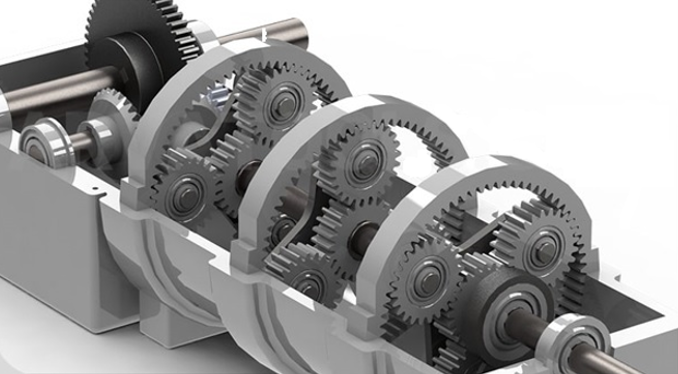
Among the various types of gearboxes, the epicyclic, or planetary, gearbox is distinguished by its sophisticated and highly efficient design. Unlike conventional gearbox configurations, this type uses multiple planetary gears that rotate simultaneously around a central gear, known as the sun gear, while being enclosed within an outer ring gear. This configuration enables balanced power transmission, higher torque capacity, and reduced mechanical stress.
Key advantages of planetary gearboxes include:
- High torque capacity in a compact package
- Very high energy efficiency
- Suitable for power transmission applications requiring continuously variable speed
- Uniform load distribution among multiple planetary gears
- Suitable for mechanically constrained and space-limited installations
Applications:
- Precision and continuous assembly lines
- Wind turbines
- Aerospace and defense industries
- Machinery with compact designs and high torque requirements
If you are looking for a gearbox that combines precision, power, and stability within a limited installation space, the planetary gearbox is considered one of the most advanced options among modern gearbox types.
- Harmonic drive
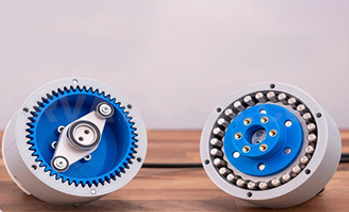
In the world of precision and advanced technologies, where even a fraction of a millimeter of mechanical backlash can affect the performance of a robot, the harmonic gearbox is recognized as one of the most precise and innovative types of gearboxes.
This gearbox utilizes the controlled flexibility of metal to achieve a unique mechanical configuration in which three primary components interact with one another:
- Flexspline: A flexible component that undergoes controlled deformation into an elliptical shape.
- Wave Generator: The primary driving component that induces the elliptical deformation in the flex spline.
- Circular Spline: The outer circular component with a fixed number of internal teeth.
As a result of this unique design, the harmonic gearbox can achieve extremely low backlash, high positioning accuracy, and very high reduction ratios within a compact package.
Key advantages and applications include:
- Zero backlash
- High positioning accuracy
- Highly compact design with high torque capacity
- Long service life due to uniform tooth engagement
- Very low operating noise
Applications of Harmonic Gearboxes:
- Industrial robots requiring precise motion control
- Space systems and aerospace equipment
- Precision control cameras and optical equipment
- Sensitive medical equipment
- CNC systems requiring micron-level accuracy
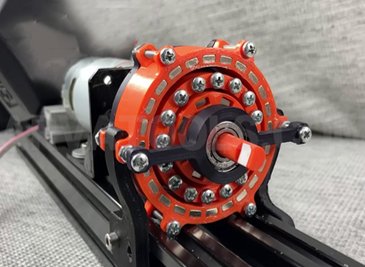
The magnetic gearbox is one of the most innovative and low-friction options among modern gearbox technologies. Unlike conventional gearboxes, which rely on physical contact and mechanical engagement between gears, a magnetic gearbox transmits power entirely without mechanical contact, using magnetic fields.
This fundamental difference provides several unique advantages:
|
Feature magnetic Gearbox
|
Mechanical Gearbox
|
Magnetic Gearbox
|
|
Physical Contact
|
Yes (Meshing Gears)
|
No(Magnetic Field Transmission)
|
|
Mechanical Wear
|
High
|
Very Low
|
|
Lubrication Required
|
Yes
|
None or Very Low
|
|
Heat Generation
|
Relatively High
|
Very Low
|
|
Suitable for Contaminated or Sterile Environments
|
Limited
|
Highly Suitable
|
|
Potential for Mechanical Overload
|
Yes (Risk of Component Failure)
|
No
(Inherent Overload Protection)
|
Specialized Applications of Magnetic Gearboxes:
- Food, pharmaceutical, and healthcare industries
- Explosion-proof equipment for hazardous and sensitive environments
- Chemical pumps and systems for handling corrosive fluids
- Isolated systems requiring contamination-free power transmission
- Specialized machinery used in cleanroom environments
- Low-friction and quiet operation
- A safe and intelligent solution for applications where physical contact may pose a contamination or safety risk
Overview of the Technical Specifications of Different Types of Gearboxes:
|
Gearbox Type
|
Power Transmission Configuration
|
Efficiency
|
Advantages
|
Limitations
|
Applications
|
|
Worm
|
Angular (90°)
|
Moderate
|
Quiet operation, compact design, self-locking capability
|
Lower efficiency, heat generation
|
Automatic doors, conveyors, elevators
|
|
Helical
|
Direct and parallel
|
High
|
Smooth operation, robust design, long service life
|
Requires more space than worm gearboxes
|
Mining, factories, heavy-duty production lines
|
|
Planetary
|
Axial, compact
|
Very high
|
High torque, balanced load distribution, compact design
|
Higher cost
|
Robotics, cranes, heavy industries
|
|
Inline
|
Linear and straightforward
|
High
|
Simple, reliable, cost-effective
|
Limited installation flexibility
|
Conveyors, packaging, agricultural machinery
|
|
Shaft-Mounted
|
Parallel, frame-mounted
|
High
|
Easy installation, suitable for heavy loads
|
Requires specific installation space
|
Mills, steel industry, continuous-duty production lines
|
|
Bevel (Crown Wheel)
|
Angular, intersecting shafts
|
High
|
Changes power transmission direction, suitable for space-constrained installations
|
More complex design
|
Agitators, angular transmission systems
|
|
Variable Speed
|
Adjustable
|
Variable
|
Speed control, flexibility
|
Maintenance-sensitive, complex design
|
Printing, textile, packaging lines
|
|
Spur
|
Direct
|
High
|
Simple construction, low cost
|
High noise, mechanical wear
|
Light-duty machinery, simple equipment
|
|
Bevel
|
Angular
|
High
|
Hypoid gear options, good efficiency
|
Requires precision design
|
Conveyors, cranes, angular drives
|
|
Epicyclic
|
Multi-axis, compact
|
Very high
|
Balanced load distribution, compact dimensions
|
High cost
|
Robotics, aerospace, turbines
|
|
Harmonic
|
Flexible, zero-backlash
|
Very high
|
Exceptional precision, low noise
|
Limited to specialized applications
|
Medical equipment, CNC systems, robots
|
|
Magnetic
|
Non-contact
|
High
|
Frictionless operation, safe and clean power transmission
|
Higher cost, emerging technology
|
Healthcare industries, sterile environments
|
Key Considerations for Selecting the Right Gearbox
Selecting the right gearbox is one of the critical decisions in the design and maintenance of mechanical and industrial systems. Despite the wide variety of gearbox types available, considering several key factors can make the selection process clearer, more accurate, and more effective.
The most important factors are discussed step by step below:
Load Type and Required Power
First, it is essential to determine the type of load the gearbox will be required to transmit:
- Continuous or intermittent
- Heavy or light
- Shock-loaded or uniform
Gearboxes such as helical and shaft-mounted models are well suited for heavy-duty loads, while lighter loads can be handled by gearbox types such as worm and spur gearboxes.
Installation Space
Is sufficient space available for gearbox installation?
- If installation space is limited, a planetary or epicyclic gearbox can provide a compact and high-performance solution.
- For open environments and large machinery, an inline or shaft-mounted gearbox may be more suitable.
Input and Output Speed
Determine the required gear ratio. Is the objective to reduce the motor speed or increase it?
- For high reduction ratios, worm and harmonic gearboxes are highly suitable.
- For applications requiring adjustable and controllable output speed, a variable speed gearbox is recommended.
Operating Environment
The installation environment has a direct impact on the gearbox's service life and performance:
- Humid, dusty, or high-temperature environments require gearboxes with robust and resistant designs.
- For hygienic, explosion-proof, or sterile environments, magnetic gearboxes can provide an excellent solution.
Maintenance Costs and Spare Parts Availability
Some gearboxes require frequent servicing and lubrication, while others offer long service life with minimal maintenance requirements.
- If maintenance is a major challenge, low-wear gearbox types such as harmonic and magnetic gearboxes can be suitable choices.
- For projects requiring rapid technical support and readily available spare parts, more commonly used types such as helical and worm gearboxes may offer greater serviceability.
When selecting a gearbox, there is no single option that is universally the best. The specific application requirements, operating conditions, and intended performance ultimately determine which gearbox type is the most appropriate choice.